

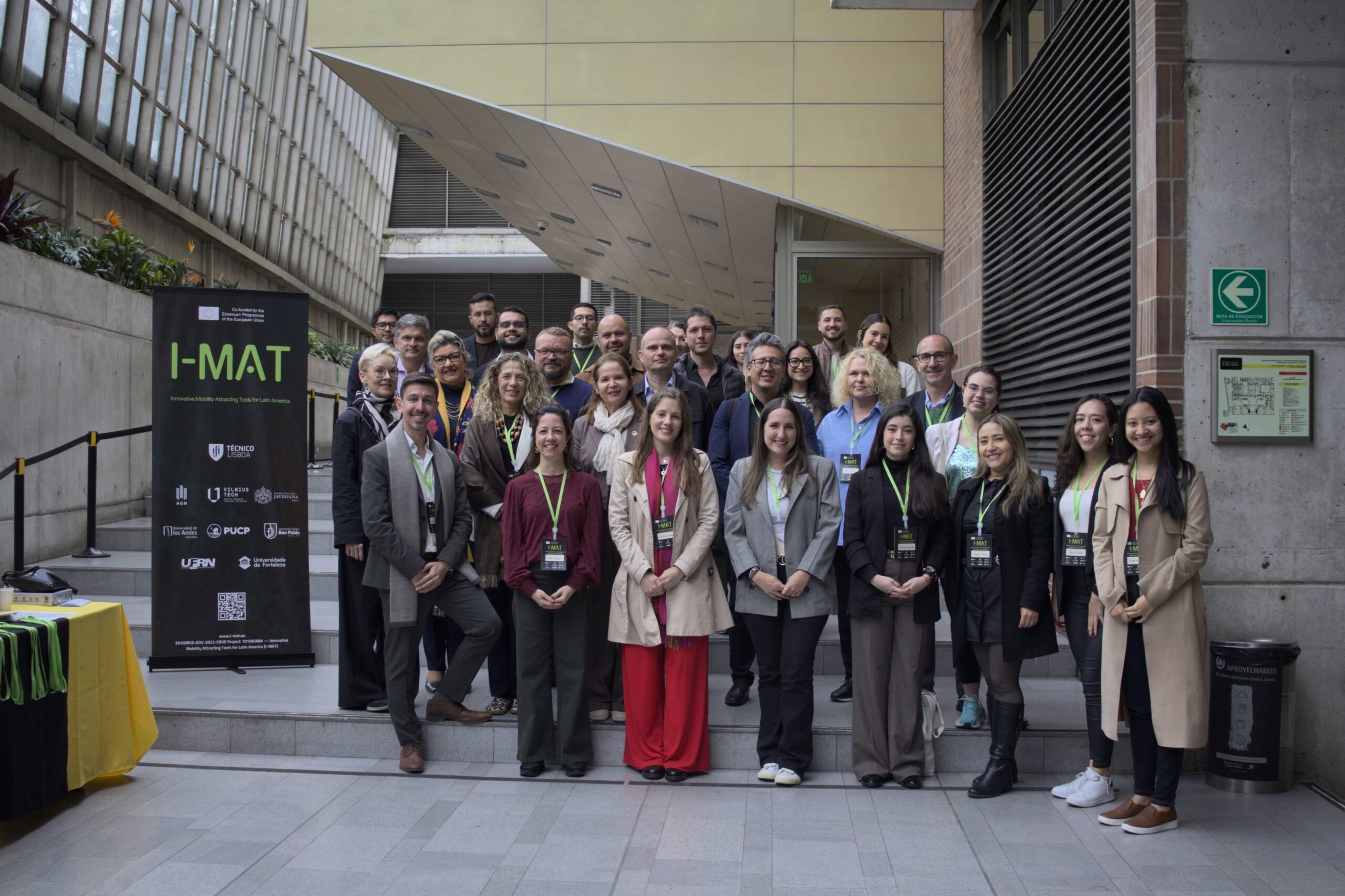
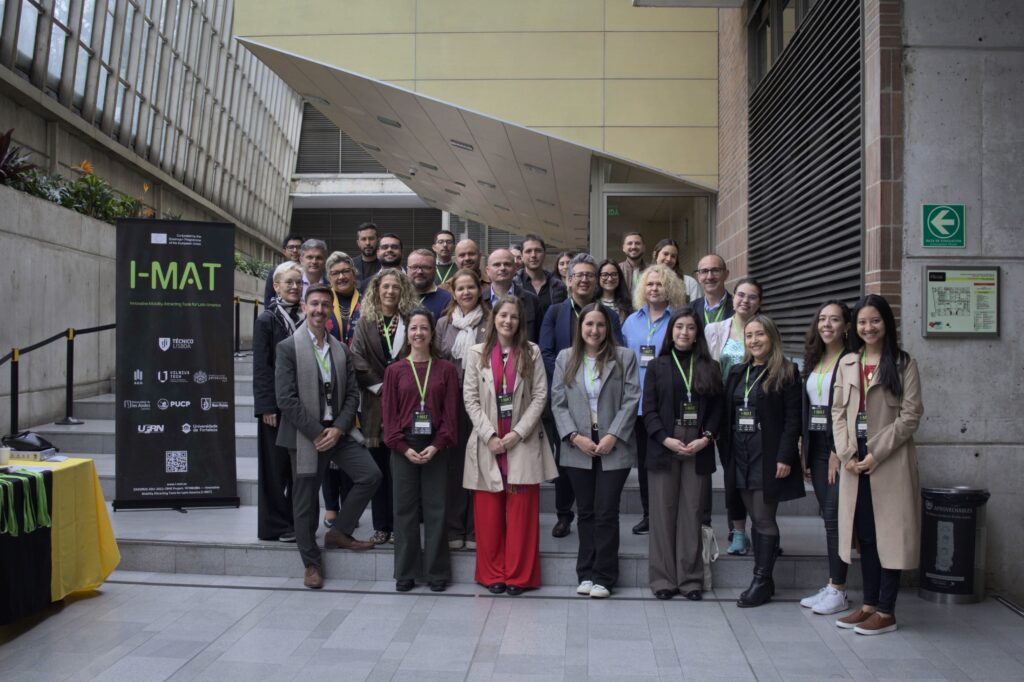
On December 3 and 4, 2025, the I-MAT 2025 International Conference marked the successful culmination of the Erasmus+ Capacity Building in Higher Education (CBHE) project Innovative Mobility Attracting Tools for Latin America (I-MAT). The event took place at the Mario Laserna Auditorium of the Universidad de los Andes in Bogotá in a hybrid format, bringing together in-person and virtual participants from Europe and Latin America.
Over the past three years, nine higher education institutions from six countries—Brazil, Colombia, Peru, Portugal, Poland, and Lithuania—worked collaboratively to identify institutional and national needs related to international mobility and develop practical tools to strengthen internationalization strategies. The conference provided a space to present the project’s main results, share lessons learned, and reflect on how these advancements can support universities seeking to expand and diversify their global reach.
Representatives from all partner institutions presented the project’s key outputs, including mobility needs analyses, training experiences, institutional recommendations, and innovative instruments designed to improve mobility management and attract international talent. Highlights included the presentation of the I-MOB digital application, the results of a large-scale international mobility survey aimed at students and staff, and a joint catalog of tools to support institutions in planning and implementing mobility initiatives.
A central moment of the conference was the keynote speech by Dr. Luciane Stallivieri, a renowned expert in the internationalization of higher education. Her presentation, titled “Internationalization 4.0: Connecting Global Knowledge for Institutional Transformation,” emphasized emerging trends such as digitally internationalized curricula, collaborative global networks, micro-credentials, and inclusive internationalization approaches that ensure greater access and social relevance.
The program also included thematic panels on Mobility Labs and Exhibitions, the use of institutional data for decision-making, and strategies for comprehensive 360-degree mobility. Partner contributions highlighted concrete experiences implemented in Brazil, Colombia, and Peru, including local training, institutional innovation processes, and community-focused internationalization initiatives.
The conference concluded with a plenary session summarizing the main achievements and outlining future perspectives. The tools, methodologies, and dissemination materials developed through I-MAT are expected to remain long-term reference resources for universities worldwide, supporting evidence-based decision-making and more inclusive and strategic international mobility.
The closing of I-MAT represents not only the completion of a project but also the consolidation of a strong interregional network committed to advancing innovative, data-driven, and socially responsible internationalization in higher education.
